
In brief
- Financial services is the most common industry named in FDE postings that specify one: 24%, ahead of government and defense at 18% (Bloomberry).
- US bank regulators replaced their 2011 model risk guidance (SR 11-7) with SR 26-2 on April 17, 2026. It explicitly leaves generative and agentic AI out of scope, but says a bank’s risk management should still guide controls for such tools (Federal Reserve).
- If a model contributes to denying credit, Regulation B requires the lender to give "specific" principal reasons (eCFR).
- Morgan Stanley’s AI assistant reached over 98% adoption among advisor teams after the firm built an evaluation framework to test every use case before deployment (OpenAI).
This guide covers US banking and lending. It is a practitioner’s map, not legal advice; the customer’s compliance and legal teams decide what applies.
What does an FDE do in financial services?
The same job as elsewhere, with heavier proof. Public postings show the shape:
| Posting | Focus | Notable requirements | Travel |
|---|---|---|---|
| Ocrolus, Mortgage FDE | Integrations for lenders on the Encompass loan platform; proofs of value with lending executives | 3+ years in mortgage or lending workflows; Python, APIs, SQL, Encompass developer tools | About 30% to 50% |
| Databricks, Sr. FDE, Financial Services | Build and productionize data and AI solutions for financial services customers on the Databricks platform | 6+ years in data engineering or software; Spark, cloud, MLOps, CI/CD | 20% |
| Anthropic, FDE, London | Production Claude applications for strategic customers | A background in financial services, healthcare, or another enterprise vertical "is a plus" | 25% to 50% |
Sources: Ocrolus, Databricks, Anthropic, accessed November 21, 2026.
Dedicated financial services FDE roles now exist at AI labs as well: OpenAI lists a Forward Deployed Engineer (FDE), Financial Services role in New York City (accessed November 21, 2026).
Typical use cases, from Bloomberry’s industry examples, include document processing, risk models, trading systems, and compliance automation (Bloomberry).
Which rules shape FDE work in a bank or lender?
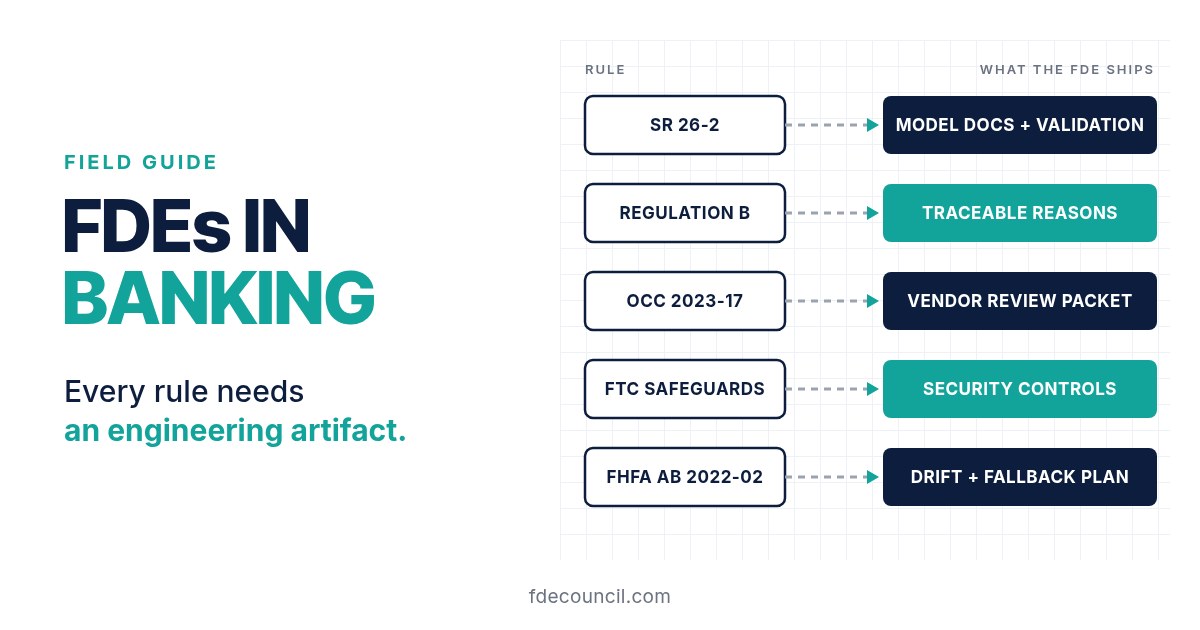
Five sets come up again and again. Each turns into a concrete engineering artifact:
| Rule or guidance | What it says (in short) | What the FDE should produce |
|---|---|---|
| SR 26-2, model risk management (Fed, OCC, FDIC; April 17, 2026) | Sound practice for developing, validating, and monitoring quantitative models; vendor models still need validation; most relevant to banks over $30 billion in assets | Model documentation, validation evidence, monitoring plan, record of customizations |
| Regulation B, 12 CFR 1002.9 | Adverse action notices must give specific principal reasons; "failed to achieve a qualifying score" is insufficient | A traceable path from each decision to its principal reasons |
| Interagency third-party guidance (OCC Bulletin 2023-17, June 6, 2023) | Banks manage third-party risk across a life cycle, scaled to risk and criticality | Answers for the bank’s vendor due diligence: architecture, data flows, controls, subcontractors |
| FTC Safeguards Rule, 16 CFR 314 (non-bank financial institutions) | A written information security program with administrative, technical, and physical safeguards | Access controls, encryption, logging that fit the customer’s program |
| FHFA AB 2022-02 (Fannie Mae and Freddie Mac; revised May 2025) | AI/ML risks include black box risk, model drift, bias, and vendor models; contingency plans with manual override | Explainability approach, drift monitoring, bias testing, fallback path |
Sources: SR 26-2 and its attachment; 12 CFR 1002.9; OCC Bulletin 2023-17; 16 CFR 314; FHFA AB 2022-02.
Does model risk guidance apply to generative AI?
Not directly under SR 26-2, but do not treat that as a free pass. SR 26-2’s attachment defines a model as "a complex quantitative method, system, or approach that applies statistical, economic, or financial theories to process input data into quantitative estimates," and excludes deterministic rule-based software. A footnote then says: "Generative AI and agentic AI models are novel and rapidly evolving. As such, they are not within the scope of this guidance. Nonetheless, a banking organization’s risk management and governance practices should guide the determination of appropriate governance and controls" for such tools (SR 26-2 attachment).
Three practical consequences for an FDE:
- Classic machine learning is in scope. A gradient-boosted credit or fraud model is a "non-generative, non-agentic AI model," and the guidance applies.
- Generative AI goes through the bank’s own governance. Expect the customer’s risk team to ask for something that looks like model validation anyway: tests, limits, monitoring, and human review.
- The guidance is risk-based. It says it "does not set forth enforceable standards," but supervisory action can still follow from "unsafe or unsound practices stemming from insufficient management of model risk."
Two more details matter if you work for a vendor. SR 26-2 says vendor models still need validation, and that when "vendor models are customized to fit a banking organization’s specific business needs," sound practice includes "documenting, justifying, and evaluating adjustments made to customize the model." Customization is exactly what FDEs do. Keep a change log from the first day.
How do you explain an AI-assisted credit decision?
Design for reasons, not just scores. Regulation B says the statement of reasons for adverse action "must be specific and indicate the principal reason(s)," and that saying the applicant "failed to achieve a qualifying score on the creditor’s credit scoring system" is insufficient (12 CFR 1002.9).
A note on sources: the Consumer Financial Protection Bureau withdrew a number of guidance documents on May 12, 2025, including Circular 2022-03 on adverse action and complex algorithms (Federal Register). The regulation itself still stands, and so does the requirement above. Ask the customer’s compliance team which interpretations they follow.
For FDE work, that means:
- Keep the decision path traceable. If a language model summarizes documents that feed a decision, log which inputs drove which output.
- Separate decision logic from narrative. Generate the reason codes from the decision model, not from free text a language model writes afterward.
- Test reasons, not just accuracy. Include cases in your evaluation set where you check that the stated reasons match the actual drivers.
The FHFA’s guidance for Fannie Mae and Freddie Mac names the same issue as "black box risk": complex models "may not offer clear relationships between model inputs and outputs that are readily understandable by humans" (FHFA).
What does a bank’s vendor review need from the FDE?
Clear, honest answers, early. The interagency guidance covers the whole third-party life cycle, from planning and due diligence through contract, monitoring, and termination, and says "not all third-party relationships present the same level of risk or criticality" (OCC Bulletin 2023-17).
The FDE usually knows the real architecture better than anyone on the vendor side. Prepare these before the security review asks:
- A data flow diagram showing where customer data goes, including any model provider.
- Data retention terms. Morgan Stanley said one of the first questions its people asked was whether their information would train public ChatGPT; OpenAI’s "zero data retention" commitment addressed it (OpenAI).
- Subprocessors and where they run.
- Access controls, encryption, and logging.
- What happens if the model provider changes or retires a model.
For non-bank lenders, the FTC Safeguards Rule requires a written information security program with "administrative, technical, and physical safeguards" suited to the institution’s size and the sensitivity of the data (16 CFR 314). Fit your controls into that program; do not build a parallel one.
How should you evaluate an AI system for a bank?
Like Morgan Stanley did: evaluate every use case before it ships, and keep testing after. OpenAI’s case study describes three habits (OpenAI):
- Expert grading. "Advisors and prompt engineers graded AI responses for accuracy and coherence."
- Daily regression. "Daily testing with a regression suite of sample questions identified potential weaknesses and improved the system’s ability to deliver compliant outputs."
- Human review. For the meeting-summary tool, "Advisors review and adjust AI-generated outputs before finalizing them."
The results: over 98% adoption among advisor teams, and access to documents rising from 20% to 80%.
Finance-adjacent work at OpenAI shows the bar can be high and specific. On Tax AI for accounting firms, automating rental-property returns "required six weeks of engineering and practitioner review to reach 90% precision and recall" (OpenAI).
Add two checks the FHFA highlights for AI/ML: drift, "the risk of model performance degradation over time," and bias, which "can lead to discriminatory or unfair outcomes" (FHFA). For more on designing evaluations, see what an AI FDE does.
What is a good FDE checklist for financial services deployments?
Use this before kickoff and again before go-live. It is the Council’s synthesis of the guidance above:
- Classify the use case. Is it a model under SR 26-2, a generative AI tool under the bank’s own governance, or deterministic software? Get the risk team’s answer in writing.
- Name the decision. Does output affect credit, pricing, fraud, or customer communications? If credit, plan for Regulation B reasons.
- Map the data. Sources, permitted uses, retention, residency, and every third party that touches it.
- Start the change log. Every customization, with the reason and the test that justified it.
- Agree the evaluation set with business experts, including edge cases and reason checks.
- Plan monitoring. Performance, drift, bias, cost, and model version.
- Design the fallback. A manual path when the system is down or uncertain; FHFA names "manual override functions" in contingency plans.
- Prepare the vendor packet for due diligence before it is requested.
- Agree human review points and who signs off.
- Name the owner at handover, with a runbook the bank’s operations team can use.
How does this map to the FDE Council framework?
Directly. The draft FDE Council Professional Capability Framework (v0.4) has 11 mandatory core domains. Domain 6 (Verification, Evaluation and Outcome Measurement) covers evaluation sets and regression checks after model changes. Domain 7 (Production Deployment, Reliability and Operations) covers runbooks, model versions, and a named owner. Domain 8 (Security, Privacy, Safety and Governance) covers controls, approvals, and escalation (framework).
The framework also names regulated-data constraints and restricted environments as context-required capabilities: needed when the deployment context demands them, rather than for every FDE. Financial services is the clearest example. The framework is a draft and has not been validated by a job task analysis. You can check your own coverage with the free self-assessment. For how this work fits a whole engagement, see the FDE delivery lifecycle.
Frequently asked questions
Do Forward Deployed Engineers work in financial services?
Yes. Among FDE postings that name a customer industry, financial services and banking is the most common at 24%, according to Bloomberry. Examples include Ocrolus’s mortgage FDE and Databricks’ financial services FDE roles.
Does SR 11-7 still apply to AI models?
No. SR 26-2, issued April 17, 2026, superseded SR 11-7 and SR 21-8. It applies to traditional statistical models and non-generative, non-agentic AI models. Generative and agentic AI are outside its scope, but banks are told to govern them through their own risk practices.
Can a lender use AI in credit decisions?
Yes, but adverse action notices must still give specific principal reasons under Regulation B. Saying an applicant failed to reach a qualifying score is insufficient, so the system must make the real drivers of each decision traceable.
What background helps an FDE get hired in financial services?
Domain knowledge helps. Ocrolus asks for three or more years in mortgage or lending workflows, and Anthropic lists a financial services background as a plus. Experience with data controls, evaluation, and working alongside risk and compliance teams is also valuable.
What should an FDE prepare for a bank’s vendor review?
A data flow diagram, data retention terms, subprocessors and hosting locations, access controls, encryption, logging, and a plan for model changes or retirement. Preparing these early keeps the third-party review from delaying the deployment.
Sources
- Board of Governors of the Federal Reserve System, OCC, and FDIC, SR 26-2: Revised Guidance on Model Risk Management, April 17, 2026, and attachment. Accessed November 21, 2026.
- Electronic Code of Federal Regulations, 12 CFR 1002.9, Notifications (Regulation B). Accessed November 21, 2026.
- Consumer Financial Protection Bureau, Withdrawal of Bureau guidance, interpretive rules, policy statements, and advisory opinions, Federal Register, May 12, 2025. Accessed November 21, 2026.
- Office of the Comptroller of the Currency, Bulletin 2023-17: Third-Party Relationships: Interagency Guidance on Risk Management, June 6, 2023. Accessed November 21, 2026.
- Electronic Code of Federal Regulations, 16 CFR Part 314, Standards for Safeguarding Customer Information. Accessed November 21, 2026.
- Federal Housing Finance Agency, Advisory Bulletin AB 2022-02: Artificial Intelligence/Machine Learning Risk Management, February 10, 2022, revised May 2025. Accessed November 21, 2026.
- OpenAI, Morgan Stanley uses AI evals to shape the future of financial services. Accessed November 21, 2026.
- OpenAI, Forward Deployed Engineer (FDE), Financial Services, job posting, New York City. Accessed November 21, 2026.
- OpenAI, What FDE means at OpenAI by Colin Jarvis, October 22, 2026. Accessed November 21, 2026.
- Bloomberry, What I learned analyzing 1K forward deployed engineer jobs, updated January 25, 2026. Accessed November 21, 2026.
- Ocrolus, Mortgage Forward Deployed Engineer; Databricks, Sr. Forward Deployed Engineer (FDE), Financial Services; Anthropic, Forward Deployed Engineer, London. Job postings accessed November 21, 2026.
- FDE Council, Professional Capability Framework, draft v0.4, November 20, 2026.
How to cite this article
FDE Council. (2026, November 21). What do Forward Deployed Engineers need to know to work in banking and financial services? https://www.fdecouncil.com/insights/forward-deployed-engineer-financial-services/. Please also cite the original source of any figure you reuse.
Get new FDE Council articles by email
No more than once a month.
Basis: Federal Reserve, OCC, FDIC, CFPB, FTC and FHFA documents, OpenAI case studies, employer postings and Bloomberry, accessed November 21, 2026, and FDE Council draft framework v0.4. The checklist is the Council’s synthesis. Not legal or compliance advice. The Council’s text and tables are licensed CC BY 4.0; third-party figures remain under their sources’ terms. Not employment or financial advice.
More FDE Council Insights · Read the open FDE framework
Related: The FDE delivery lifecycle · How to measure FDE deployment success · What FDE job postings ask for · Forward Deployed Engineer job description template.