
In brief
- OpenAI’s head of forward deployed engineering founded the team in early 2025 to close what he calls "the deployment gap" between what models appear capable of and what people can reliably use (OpenAI).
- Among 1,000 FDE postings, 35% mention AI agents, 31% LLM experience, and 12% retrieval-augmented generation, while PyTorch appears in 6% (Bloomberry).
- At Morgan Stanley, an evaluation framework that tested every AI use case before deployment came before over 98% adoption of its advisor assistant (OpenAI).
- In the FDE Council framework, AI and agent engineering is a context-required capability, used when a deployment calls for it. It is not a twelfth core domain (framework).
How is an AI FDE different from any other FDE?
The role is the same; the risks and the evidence are different. An FDE embeds with a customer and is judged on a production outcome the customer owns. The FDE Council definition of a Forward Deployed Engineer covers the role in full.
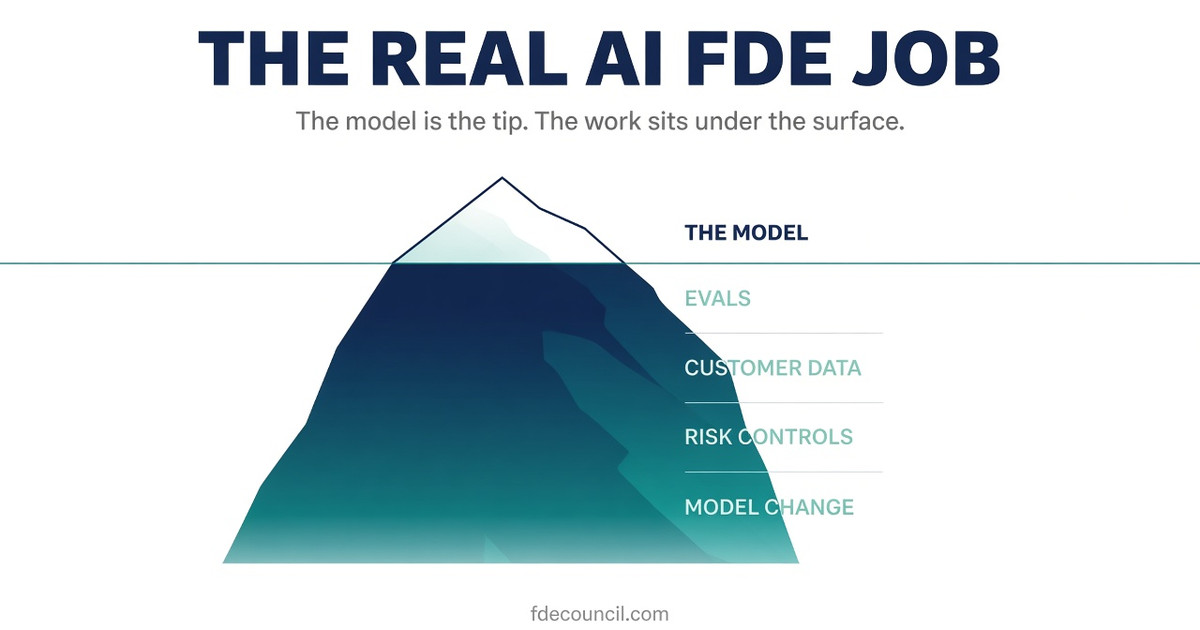
What changes with AI is that the system’s behavior is no longer fully determined by its code. The same input can produce different outputs, a provider can change or retire the model underneath you, and text the model reads can try to give it instructions. The draft FDE Council Professional Capability Framework (v0.3) handles this without inventing a new kind of engineer. It keeps the 11 core domains and adds AI and agent engineering as a context-required capability: prompting and structured outputs, retrieval over the customer’s content, tool calling and multi-step agents, a person able to intervene where the risk requires it, prompt injection mitigation and data-leak controls, and a plan for model version drift and retirement (framework).
The framework is explicit that "many FDE deployments never use either" a language model or an agent. An "AI FDE" is an FDE in that context, not a separate profession. That matters for hiring: someone who can prompt a model but cannot do discovery, integration, or handover is not yet an AI FDE.
What does an AI FDE engagement look like from start to finish?
It usually runs in three phases, with evaluation in the middle rather than at the end. OpenAI’s head of FDE, Colin Jarvis, described his team’s structure to The Pragmatic Engineer in August 2025 (The Pragmatic Engineer):
| Phase | What happens | What it produces |
|---|---|---|
| Early scoping | A couple of days on site; sit with users, map processes, prototype with synthetic data | A ranked list of the most valuable use cases |
| Validation | Agree validation criteria; build evals with user input and labeling; improve against them | A report showing eval performance against the objectives |
| Delivery | On site a few days a week; get real data; build the smallest end-to-end unit | A working solution in the customer’s environment |
Jarvis explained why validation comes before delivery: "often what the customer describes in scoping doesn’t match the data/system reality on the ground." The aim is to find "any brick walls" early and adjust scope (The Pragmatic Engineer).
Timelines in published examples are measured in months, not days. Cresta says most of its AI agent deployments move from kickoff to production in one to three months (Cresta). At Morgan Stanley, Jarvis said on a podcast that the technical scaffolding took six to eight weeks, while convincing financial advisors to trust the tool took another four months of pilots, evaluations, and iteration (Business Insider). The model was rarely the slow part. Trust was.
Why are evaluations the center of the job?
Because an AI system that cannot show it works will not be allowed into production, and will not be used if it is. An evaluation, or "eval," is a repeatable test of a model-based system against cases that represent the real job, with an agreed pass mark.
Published cases show the pattern:
- Morgan Stanley. Advisors and prompt engineers graded model summaries for accuracy and coherence. The team ran daily tests with a regression suite of sample questions, and access to documents rose from 20% to 80% (OpenAI).
- A telecom voice deployment. During scoping, OpenAI’s model scored around 60% on the evals that decided production readiness. Over six months, with Research involved, it rose to 80% and then above 90% (OpenAI).
- Tax returns. For Thrive Holdings’ Tax AI, rental-property returns took six weeks of engineering and practitioner review to reach 90% precision and recall (OpenAI).
- Vertical fit. Cresta says it never ships without evals, because a prompt that works in one industry can fail in another. Its example: empathy suits healthcare, but an agent being overly empathetic with someone who owes $4,000 in fintech gets mixed reactions (Cresta).
The FDE Council framework puts this in Domain 6 (verification, evaluation and outcome measurement). When a system uses a model, the evidence includes "an agreed test set, allowance for answers that are not deterministic, and a regression check after the model changes" (framework). A practical eval plan an AI FDE can agree with the customer in week one:
- Cases. Real examples labeled by the people who do the work, including the awkward ones.
- Pass mark. The threshold the business owner signs, and what happens below it.
- Variation. Run each case more than once and decide how much spread is acceptable.
- Failure review. Read the failures, not only the score. Group them by cause.
- Regression. Re-run the set on every prompt, retrieval, or model change before release.
- Live check. Sample production outputs on a schedule, reviewed by a person.
Then connect the eval to the workflow. A 90% score means nothing if adoption stays flat. The Council’s guide to measuring FDE deployment success covers the four kinds of evidence that separate a production outcome from a pilot.
What do AI FDEs actually build?
Connections, harnesses, and controls more than models. Anthropic’s FDE posting lists "MCP servers, sub-agents, and agent skills that will be used in production workflows" as deliverables (Anthropic). The Model Context Protocol (MCP) is "an open-source standard for connecting AI applications to external systems" such as databases, tools, and workflows (Model Context Protocol). In plain terms, an MCP server is the adapter that lets an AI application read from or act on a customer system in a standard way.
The best AI FDE work makes itself smaller over time. In one OpenAI semiconductor engagement, about 15 FDEs built custom tools for more than ten use cases. When the underlying product matured, the team moved the use cases onto a common harness and removed roughly 90% of the custom code from each project. In one August 2026 example, the first deployment took two months and extending it to a second team took one day (OpenAI).
That is the field-learning loop in Domain 11 of the framework: turn bespoke work into reusable assets and product feedback. An AI FDE who only ships one-off prompts is building tomorrow’s maintenance problem.
Which risks does an AI FDE own?
Four risks show up in almost every model-based deployment, and each sits in a specific part of the framework:
| Risk | What can happen | Typical controls | Where it sits in draft v0.3 |
|---|---|---|---|
| Prompt injection | Text in a file, web page, or message makes the model ignore instructions, leak data, or call a tool it should not | Least-privilege tool access, human approval for high-risk actions, separating untrusted content, adversarial testing | AI and agent engineering; Domain 8 |
| Data leaving through tools | An agent sends customer data to a system or person outside the agreed boundary | Allow-listed tools and destinations, logging, data classification | AI and agent engineering; Domains 4 and 8 |
| Model change or retirement | Behavior shifts after a version change, or requests fail after retirement | Pin the model version, regression evals, a named replacement plan | Domains 6 and 7 |
| Runaway cost | Token and inference spend outgrows the value | Cost per task tracked against the baseline, limits, caching | Domain 7 and Domain 10 |
On prompt injection, the OWASP Gen AI Security Project ranks it first in its 2025 list and says it is "unclear if there are fool-proof methods of prevention" (OWASP). The framework says the same: prompt injection cannot be fully prevented, so design for limiting the damage.
On model retirement, the risk is concrete. Anthropic gives at least 60 days’ notice before retiring publicly released models. On September 30, 2026, it notified developers that Claude Sonnet 4.5 would retire on November 30, 2026, after which requests to it fail (Anthropic). A deployment handed over without a model version in the runbook and a tested replacement is a deployment with an expiry date nobody wrote down.
What skills do AI FDE job postings ask for?
Production engineering first, then language model experience on top. OpenAI’s posting asks for 5 or more years of engineering or technical deployment experience that includes customer-facing work, production code across frontend and backend, and experience building or deploying systems powered by LLMs (OpenAI). Anthropic asks for 4 or more years in a technical, customer-facing role, production LLM experience including evaluation frameworks, and strong Python (Anthropic).
Across all FDE postings, Bloomberry found generative AI skills far ahead of classic machine learning: AI agents 35%, LLM experience 31%, RAG 12%, OpenAI 8%, Anthropic or Claude 7%, PyTorch 6%, TensorFlow 4% (Bloomberry). The lesson: AI FDE work is mostly about deploying and evaluating existing models, not training new ones.
Demand is broad. Amazon said in July 2026 it would invest $1 billion to build AWS Forward Deployed Engineering, a team that works inside customer organizations to launch agentic AI systems (Business Insider). For pay, see the Council’s monthly FDE Salary Report.
Will AI make the FDE role obsolete?
Not soon, but it keeps moving the work. Jarvis opens his own essay on the role with the question his team asked when Codex arrived: what do we do when it can one-shot the use cases we spent months building? His answer: "If we make ourselves obsolete every couple of months, our FDE team is doing its job," and then "go find the harder problem" (OpenAI).
The Council’s reading: as coding assistants make software cheaper to build, the scarce parts of the job are the ones models do not do for you. Those are discovery, evaluation design, adoption, controls, and handover, which are Domains 1, 6, 7, 8, and 9. Jarvis makes a similar point: as software gets faster to build, "understanding the customer’s business becomes even more important" (OpenAI).
How do you become an AI FDE?
Become an FDE first, then add the AI capability with evidence. The Council’s career guide covers the core path. For the AI layer, build one small system end to end on real documents: retrieval, a structured output, one tool call, an eval set labeled by a real user, a regression run after a model swap, and a runbook naming the model version. Then check your gaps with the free self-assessment. If you are designing a course, the Council’s guide to mapping a learning path to the framework explains where agents belong.
Frequently asked questions
What is an AI Forward Deployed Engineer?
An AI Forward Deployed Engineer is an FDE whose deployments use language models or agents. They embed with a customer, connect models to the customer’s data and tools, build evaluations the customer trusts, control risks like prompt injection, and hand over a system the customer can run, including a plan for model changes.
Is an AI FDE different from an AI engineer?
Yes. An AI engineer may build model-based features inside one product. An AI FDE does that inside a customer’s environment and owns the whole outcome: discovery, integration, evaluation, adoption, controls, and handover. The customer-facing ownership is what makes it an FDE role.
Do AI FDEs train models?
Rarely. Postings emphasize deploying existing models: Bloomberry found AI agents in 35% of FDE postings and LLM experience in 31%, but PyTorch in only 6%. The work is mostly retrieval, tool integration, evaluation, and operations around models someone else trained.
What is an eval in an AI deployment?
An eval is a repeatable test of a model-based system against real cases, with a pass mark the business agrees. A good eval set is labeled by the people who do the work, run more than once to allow for varying answers, and re-run after every prompt, retrieval, or model change.
What should an AI FDE hand over at the end?
A system the customer can run without them: the agreed eval set and results, a regression process, monitoring, a runbook naming the model version and its replacement plan, cost tracking, and a named owner. Without the model plan, a provider retirement can break the system.
Sources
- OpenAI, What FDE means at OpenAI by Colin Jarvis, October 22, 2026. Accessed November 14, 2026.
- OpenAI, Morgan Stanley uses AI evals to shape the future of financial services. Accessed November 14, 2026.
- OpenAI, Forward Deployed Engineer (FDE), SF, job posting. Accessed November 14, 2026.
- Anthropic, Forward Deployed Engineer, London, job posting. Accessed November 14, 2026.
- Anthropic, Model deprecations. Accessed November 14, 2026.
- The Pragmatic Engineer, What are Forward Deployed Engineers, and why are they so in demand? by Gergely Orosz, August 12, 2025 (partly paywalled; cited sections are in the free preview). Accessed November 14, 2026.
- Business Insider, An OpenAI exec explains how his growing team helps companies move from AI hype to adoption by Lee Chong Ming, November 28, 2025. Accessed November 14, 2026.
- Business Insider, Amazon is investing $1B in a hot new tech role by Katherine Li, July 31, 2026. Accessed November 14, 2026.
- Cresta, How Cresta Built a World-Class Forward Deployed Engineering Team in a Year by Jove Zhong, October 6, 2026. Accessed November 14, 2026.
- Bloomberry, What I learned analyzing 1K forward deployed engineer jobs by Henley Wing Chiu, updated January 25, 2026. Accessed November 14, 2026.
- OWASP Gen AI Security Project, LLM01:2025 Prompt Injection. Accessed November 14, 2026.
- Model Context Protocol, What is the Model Context Protocol?. Accessed November 14, 2026.
- FDE Council, Professional Capability Framework, draft v0.3, November 7, 2026.
How to cite this article
FDE Council. (2026, November 14). What does an AI Forward Deployed Engineer do? https://www.fdecouncil.com/insights/ai-forward-deployed-engineer/. Please also cite the original source of any figure you reuse.
Get new FDE Council articles by email
No more than once a month.
Basis: OpenAI, Anthropic, OWASP, Model Context Protocol, Cresta, Bloomberry and Business Insider pages accessed November 13, 2026, and FDE Council draft framework v0.3. The eval plan and risk table are the Council’s synthesis of those sources. The Council’s text and tables are licensed CC BY 4.0; third-party figures remain under their sources’ terms. Not employment or financial advice.
More FDE Council Insights · Read the open competency framework
Related: How to become a Forward Deployed Engineer · What FDE job postings ask for · How to measure FDE deployment success.