
In brief
- Investors have published the economics. At IPO, ServiceNow’s gross margin was 63.2% and Workday’s 54.1%; by 2024 they were 79% and 75% (a16z). Heavy early services can pay off if the product absorbs the work.
- Andreessen Horowitz warns that copying only the embedded engineers leaves "thousands of bespoke deployments that are impossible to maintain or upgrade," turning "Palantir for X" into "Accenture for X" (a16z).
- OpenAI’s FDE head says his team avoids "services revenue" and focuses on product playbooks (Business Insider). Databricks, by contrast, places FDEs in professional services and says "FDEs are billable" (Databricks).
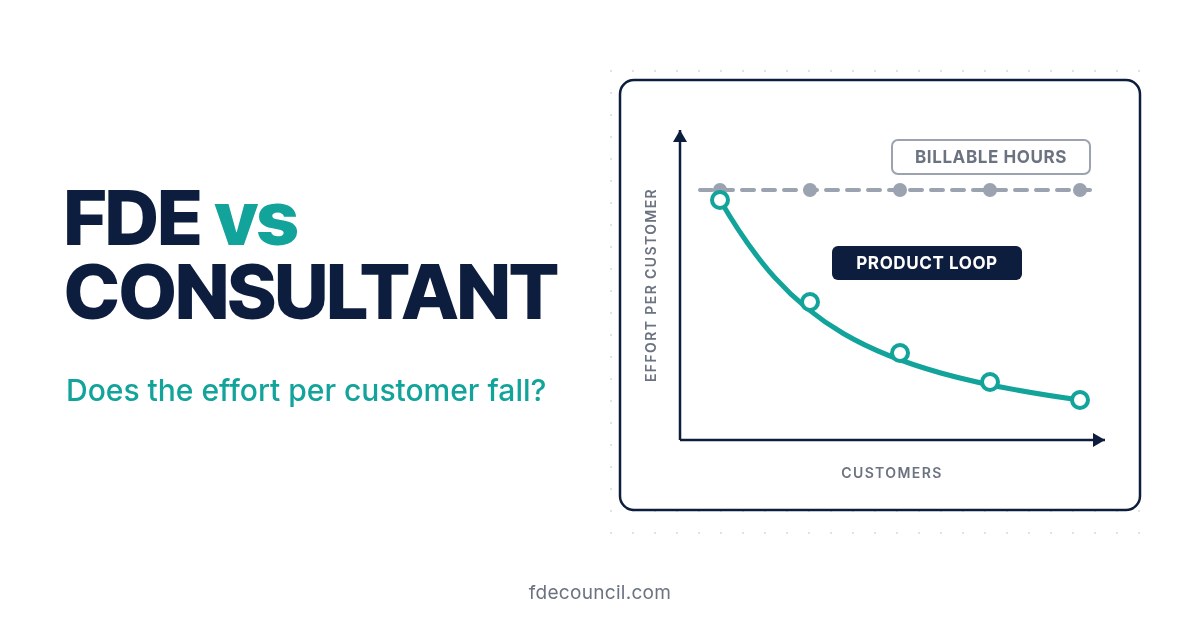
- The test is not the org chart. It is whether forward-deployed effort per customer goes down over time.
What is professional services in a software company?
Professional services (PS) is the paid delivery arm of a software vendor: implementation, configuration, integration, migration, and training, usually sold as a project or by the hour. Its job is to make a customer successful with the product as it exists. Its economics are those of a services business: revenue scales with people, and margins are lower than software.
That is not a criticism. Andreessen Horowitz partner Martin Casado argued in 2018 that services are often essential in enterprise software: "The standard advice is to keep services to less than 20% of total revenue," but "many successful enterprise products have services that accounted for over 40% of revenue early on." He also warned founders not to "build a services organization by accident" (a16z).
What makes Forward Deployed Engineering different?
The feedback loop. An FDE team exists to get the product into production use and to change the product with what it learns.
Published descriptions say this directly:
- OpenAI: "Our goal is for each engagement to leave the next customer with a better starting point." Its FDEs removed roughly 90% of the custom code from each project in one engagement by moving use cases onto a common harness (OpenAI).
- Cresta: "We don’t bill hours and walk away with a forked codebase. Our agents run on a shared platform" (Cresta).
- Palantir, as summarized in an Everest Group report quoted by a16z: "Unlike consulting firms, services are a means to drive product adoption, not the primary revenue stream" (a16z).
The Pragmatic Engineer reported that when OpenAI set up its FDE team in 2025, it differentiated FDE from "the professional services-type job of Solution Architect" (The Pragmatic Engineer).
How do FDE and professional services compare?
| Aspect | Professional services | Forward Deployed Engineering |
|---|---|---|
| Primary goal | Deliver the contracted project | Get the product into production use and improve the product |
| Usually measured on | Utilization, billable hours, project margin, on-time delivery | Production adoption, customer outcomes, reuse, product changes |
| Revenue model | Sold as services, often time and materials or fixed fee | Often bundled with software or sold at cost; sometimes billable |
| Relationship to product code | Configures and extends; rarely changes the core product | Expected to feed changes back; at some companies commits directly |
| What good looks like over time | Steady, profitable delivery capacity | Less custom work per new customer |
| Who staffs it | Consultants, implementation engineers, architects | Software engineers with customer and domain judgment |
| Compared with a consultant | Close to consulting: expert time sold against a scope | A means to drive product adoption, not the main revenue stream |
| Typical risk | Becomes the bottleneck to growth | Drifts into professional services without noticing |
This is a comparison of models, not of people. Many excellent FDEs come from consulting and services backgrounds; Bloomberry’s profile review lists consulting as one of the main paths into the role (Bloomberry).
How is a Forward Deployed Engineer different from a consultant?
A consultant sells expertise to a client, often to diagnose a problem or deliver a scoped project. A Forward Deployed Engineer works for the company that makes the product, writes production code in the customer’s environment, and stays accountable until the system is in real use. In the Everest Group summary quoted by a16z, Palantir’s services are "a means to drive product adoption, not the primary revenue stream," which is the opposite of a consulting business (a16z).
The overlap is real. McKinsey notes that embedding engineers inside a client’s systems and data is a service consulting firms and technology providers have offered for years (McKinsey), and Bloomberry lists consulting as one of the main paths into the FDE role (Bloomberry). The practical test is ownership: if the role ships and maintains production code for a product company, it is FDE; if it sells expert hours against a statement of work, it is consulting.
Why do the economics matter so much?
Because they decide whether embedded engineering is an investment or a permanent cost.
Andreessen Horowitz partner Joe Schmidt calls the trade "margin for moat." Complex systems of record needed heavy customization at first: ServiceNow’s gross margin at IPO was 63.2% and Workday’s 54.1%, "far below the ideal ~80% for software." Salesforce "reportedly burned over $52 million to generate $22 million in revenue before developing its partner ecosystem." Once workflows were embedded, pricing power followed: in 2024 ServiceNow’s gross margin was 79% and Workday’s 75% (a16z).
The same logic applies to FDE teams today. Marc Andrusko of Andreessen Horowitz says many early-stage companies "will gladly trade gross margin for momentum" to land seven-figure deals. His warning: "The problem is pretending you’re SaaS when you’re really services with a platform" (a16z).
So the question is never "Are we spending on embedded engineers?" It is "Is that spending building something that makes the next customer cheaper?"
How can you tell if an FDE team is really professional services?
Run this eight-point diagnostic. It is the Council’s synthesis of the sources above, built so engineers evaluating a job and leaders evaluating their own team can use it. Each "yes" points toward professional services:
- Is the team mainly measured on billable utilization? Utilization targets reward hours, not reuse.
- Does each deployment start from scratch? No shared components, templates, or connectors carried between customers.
- Is custom code kept in customer-specific forks that never return to the product?
- Does forward-deployed effort per customer stay flat or rise as the customer count grows? Andrusko’s diligence question is whether that effort will "go down meaningfully over time."
- Is there no regular channel to product and research? No readouts, no field notes, no way for a field fix to become a feature.
- Do engagements end at go-live, with no ownership of adoption, monitoring, or handover?
- Is the scope set by what the customer will pay for, rather than by what the product should do?
- Are the engineers not expected to write production code?
Zero to two "yes" answers looks like forward deployed engineering. Three to five is a hybrid; ask what the plan is to move each answer. Six or more is professional services with an FDE title. That can still be a good job or a sound business; it should just be named honestly.
When is professional services the right model?
When the product is mature, deployments are repeatable, and customers want a vendor to run a project. Three signals:
- The work is configuration, not discovery. You know what to build; you need people to build it reliably.
- The customer wants to pay for delivery capacity. Some buyers prefer a fixed-scope statement of work.
- Partners can do it. Casado describes startups that build a services business and later "offload the services business to the channel," because "service revenue is often far more attractive to channel partners than software license revenue" (a16z).
FDE fits better when the problem is new, the right solution is not yet known, and what the team learns should change the product. Andrusko’s gating questions on problem criticality, customer concentration, domain fragmentation, and regulatory and data gravity help decide (a16z).
Many companies run both: FDEs for new and hard problems, services or partners for repeatable rollouts. For how to structure the FDE side, including reporting lines and pod staffing, see how to build and structure an FDE team.
Can a billable FDE team still be "real" FDE?
Yes, if the feedback loop is real. Billing is a commercial choice; it does not decide the model on its own. Databricks says its FDEs are billable, and the same posting asks them to "contribute accelerators, frameworks, and best practices that scale impact across accounts and influence the Databricks product roadmap" (Databricks).
Schmidt suggests designing incentives "that allow services to be sold at cost," and notes "it’s rare to find implementation leads that want to carry a quota" (a16z). Whatever the billing model, the diagnostic questions above are a better test than the invoice.
What does this mean for engineers choosing a role?
Ask the diagnostic questions in the interview. Good ones to say out loud:
- "How much of what you built for your last customer was reused for the next one?"
- "When an FDE finds a product gap, what happens next, and how long does it take?"
- "Are FDEs measured on utilization?"
- "Who owns the system six months after go-live?"
Clear, specific answers are a good sign. The Council’s FDE interview guide has more questions to ask. If you are comparing FDE with solutions engineering or consulting more broadly, see FDE vs solutions engineer vs software engineer.
The FDE Council Professional Capability Framework (draft v0.4) builds the feedback loop into the role itself: Domain 11, Field Learning, Product Feedback and Reuse, asks every FDE to convert field experience into actionable feedback, reusable assets, and improvements to future deployments (framework). The framework has not yet been validated by a job task analysis, but that domain is a useful line between the two models.
Frequently asked questions
Is Forward Deployed Engineering just professional services?
No, though it can drift into it. Professional services delivers projects and grows with billable hours. Forward Deployed Engineering embeds engineers to get a product into production and feeds what they learn back into the product, so each new deployment needs less custom work.
Why do software companies avoid services revenue?
Services revenue scales with headcount and carries lower margins than software. Andreessen Horowitz notes the standard advice to keep services under 20% of revenue, though some successful enterprise companies exceeded 40% early. OpenAI’s FDE head says his team avoids services revenue entirely.
Are FDEs billable?
It depends on the company. Databricks says its FDEs are billable and places them in professional services. Cresta says it does not bill hours. Billing alone does not make a team professional services; the feedback loop into the product matters more.
How do you know if an FDE role is really a consulting role?
Ask whether FDEs write production code, whether work is reused across customers, whether there is a regular channel into product, whether the team is measured on utilization, and whether effort per customer falls over time. Mostly "no" on reuse and feedback suggests consulting.
When should a company use professional services instead of FDEs?
When deployments are repeatable configuration rather than discovery, when customers want to pay for fixed-scope delivery, or when channel partners can do the work. FDE fits new, high-stakes problems where the solution is not yet known.
Sources
- Andreessen Horowitz, Trading Margin for Moat: Why the Forward Deployed Engineer Is the Hottest Job in Startups by Joe Schmidt, June 4, 2025. Accessed November 20, 2026.
- Andreessen Horowitz, The Palantirization of everything by Marc Andrusko, January 16, 2026. Accessed November 20, 2026.
- Andreessen Horowitz, The Case for Services in Enterprise Software Startups by Martin Casado, March 12, 2018. Accessed November 20, 2026.
- Business Insider, An OpenAI exec explains how his growing team helps companies move from AI hype to adoption, November 28, 2025. Accessed November 20, 2026.
- OpenAI, What FDE means at OpenAI by Colin Jarvis, October 22, 2026. Accessed November 20, 2026.
- Cresta, How Cresta Built a World-Class Forward Deployed Engineering Team in a Year by Jove Zhong, October 6, 2026. Accessed November 20, 2026.
- Databricks, Sr. Forward Deployed Engineer (FDE), Financial Services, job posting. Accessed November 20, 2026.
- The Pragmatic Engineer, What are Forward Deployed Engineers, and why are they so in demand? by Gergely Orosz, August 12, 2025 (cited section is in the free preview). Accessed November 20, 2026.
- Bloomberry, What I learned analyzing 1K forward deployed engineer jobs, updated January 25, 2026. Accessed November 20, 2026.
- McKinsey & Company, What is a forward-deployed engineer?, McKinsey Explainers, October 16, 2026. Accessed November 20, 2026.
- FDE Council, Professional Capability Framework, draft v0.4, November 20, 2026.
How to cite this article
FDE Council. (2026, November 20). Forward Deployed Engineer vs consultant vs professional services: what is the difference? https://www.fdecouncil.com/insights/forward-deployed-engineering-vs-professional-services/. Please also cite the original source of any figure you reuse.
Get new FDE Council articles by email
No more than once a month.
Basis: Andreessen Horowitz, OpenAI, Cresta, Databricks, Business Insider, The Pragmatic Engineer, Bloomberry and McKinsey pages accessed November 20, 2026, and FDE Council draft framework v0.4. The diagnostic is the Council’s synthesis. The Council’s text and tables are licensed CC BY 4.0; third-party figures remain under their sources’ terms. Not employment or financial advice.
More FDE Council Insights · Read the open FDE framework
Related: FDE vs solutions engineer vs software engineer · How to measure FDE deployment success · The FDE delivery lifecycle.