
In brief
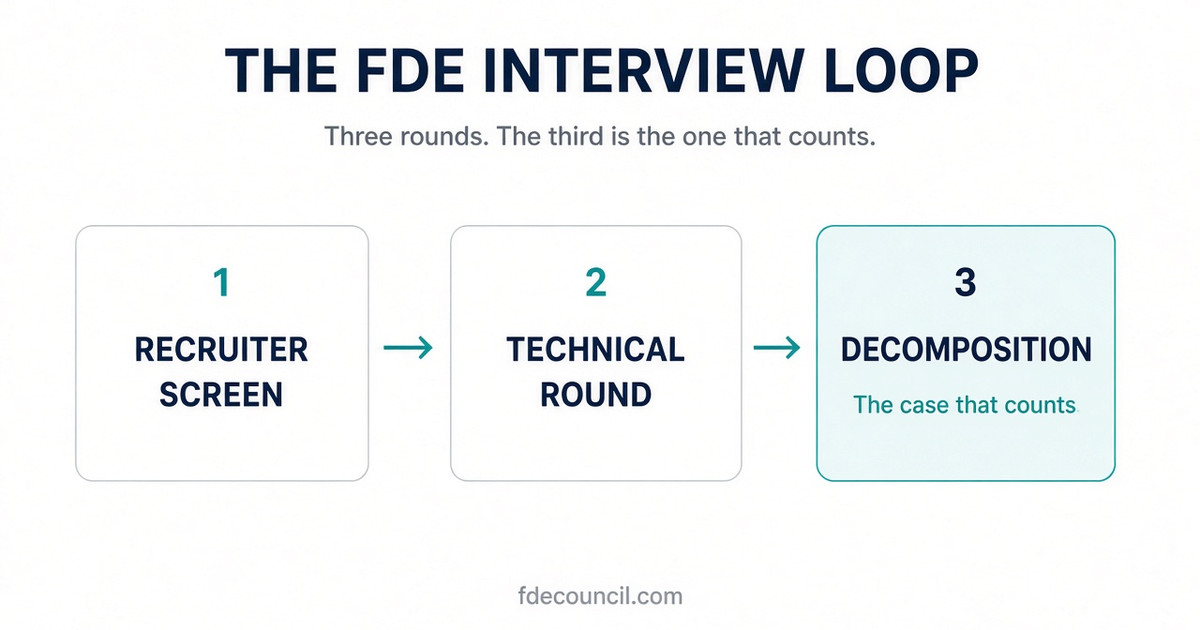
- Across 1,095 FDE candidate reports, Dataford puts the median loop at 3 rounds. A recruiter screen appears in 67% of reports, technical interviews in 64%, and an assessment or take-home in 61% (Dataford).
- Palantir, which created the role, says everyone starts with one or two phone interviews, then an onsite round, and its interview guidance asks candidates to "deliver a functioning idea first, then expand it afterwards" (Palantir).
- Some FDE teams screen hardest for judgment, not code. Cresta’s head of FDE says its interviews ask what happened when a candidate’s AI agent made a mistake in front of a customer (Cresta).
- The decomposition round is the one ordinary software interviews do not prepare you for. Practice it more than anything else.
What rounds does a Forward Deployed Engineer interview loop have?
Usually three, though what counts as a "round" varies. Dataford aggregates 1,095 candidate reports and 202 company guides for FDE roles and reports a median loop of 3 rounds. It also lists how often each stage shows up in those reports (Dataford):
| Stage | What it covers | Share of reports |
|---|---|---|
| Recruiter or HR screen | Background, motivation, level, timeline | 67% |
| Technical interviews | Deep dives on core skills | 64% |
| Assessment or take-home | Online test, case study, or take-home | 61% |
| Behavioral and culture fit | Past situations, collaboration, values | 36% |
| Final or onsite round | Multi-interview loop, sometimes with leadership | 33% |
| Short technical screen | Live technical round before the main loop | 30% |
| Panel or team interview | Several interviewers at once | 10% |
Two cautions. First, these are self-reported experiences, so they skew toward people who chose to write them up. Second, a half-day onsite with three interviews can be logged as one round, so "three rounds" may mean five or six conversations.
Palantir describes its own process in general terms: one or two phone interviews, then an onsite, with the number and format "personalized to your skillset and the type of role" (Palantir). One candidate report on Dataford, dated July 5, 2026, describes a Palantir loop of recruiter screen, a decomposition round, then an onsite with three interviews covering coding, learning, and decomposition (Dataford). Treat any single report as one data point, not the rule.
What is the decomposition interview?
It is a case interview for engineers. You get an open problem, often with no code, and you are graded on how you break it down, what you ask, and whether you land on something you could actually build. Palantir’s interview guidance describes the same skill: "articulate the alternatives and trade-offs, but don’t forget to be pragmatic enough to be able to arrive at some concrete approach" (Palantir).
Most advice online gives a generic five-step method. A better test of your answer is to ask whether it covers the work an FDE is actually accountable for after the interview ends. The FDE Council’s open Professional Capability Framework (draft v0.3) names 11 core domains. Eight of them map neatly onto a decomposition answer:
- Who has the problem, and who decides? Name the user, the decision maker, and the outcome they are measured on (Domain 1, discovery and problem framing).
- What happens today, and what is the baseline? Describe the current workflow and the one number you would move (Domain 2, workflow design and value definition).
- What data exists, and who allows access? List the sources, their owners, freshness, and quality problems (Domain 4, data foundations).
- What is the smallest end-to-end slice? Propose a thin version a real user could use soon, inside the existing systems (Domains 3 and 5).
- How would you prove it works? Say what test, comparison, or acceptance threshold you would use, and how it could fail (Domain 6, verification and evaluation).
- Who runs it after you leave? Name the owner, the runbook, and what gets monitored (Domain 7, production and operations).
- What could go wrong for people or data? Approvals, privacy, and where a human must be able to intervene (Domain 8, security and governance).
- Go, reshape, or stop? Say what you would do if the data or sponsorship is not there (Domains 1 and 10).
Steps 6 to 8 are where strong candidates separate from average ones. Most candidates stop at "here is what I would build." Interviewers for this role want to hear that you have thought about the system surviving contact with real users.
A worked example
Suppose the prompt is: "A regional lender says loan files take too long to review. What would you do?"
- Clarify the outcome. "Too long" from when to when? Application received to underwriting decision? Which loan types? Who complains: borrowers, loan officers, or the head of operations who owns the cost?
- Baseline. Ask for the current median and the worst 10% of review times by loan type. If nobody knows, measuring it is the first deliverable.
- Data and access. Loan origination system records, uploaded documents, underwriter notes. Who approves access to borrower data, and can you work with a sample in their environment?
- Smallest slice. Pick one loan type. Flag files with missing documents on day one, so underwriters stop discovering gaps on day five. No model needed yet.
- Proof. Compare time to decision for flagged files against the baseline for four weeks. Count false flags.
- Handover. Operations owns the daily report; a named engineer on the lender’s side owns the integration.
- Controls. If you later add AI to read documents, keep a human reviewer on every adverse decision, because lenders must give applicants specific reasons for a denial (eCFR, Regulation B).
- Stop condition. If the delay is mostly waiting on third parties such as appraisals, say so and reshape the problem.
Notice what is missing: no model architecture in the first ten minutes. You earn the right to talk about technology by showing you understand the work.
What does the technical round test?
Practical engineering more than puzzles, though some companies still ask algorithm questions. Kanav Bhatnagar, a senior FDE at Rippling, told Business Insider that FDE interviews feature technical rounds that test coding skills "like in traditional software engineering interviews," plus rounds where you talk through how you would design a solution for a customer (Business Insider). Among the topics Dataford tags in FDE company guides, Python and data pipelines each appear in 16% (Dataford).
Prepare for the work FDEs actually do in the first week of a deployment:
- Parse and clean an ugly file: inconsistent dates, duplicate keys, missing values.
- Call a paginated API, handle errors and rate limits, and join the result to a table.
- Write a small service with tests, then explain what you would monitor in production.
- Read unfamiliar code and change it safely. Palantir lists "working inside existing systems" as one of its interview competencies (Palantir).
Talk while you code. In a customer setting, silence reads as being stuck. In an interview, it hides the reasoning the interviewer is trying to grade.
What does the customer or behavioral round look for?
Evidence that you can be trusted in front of a customer when things go wrong. Cresta, whose FDE team grew from 1 to more than 50 people in a year, says it hires FDEs "for judgment, not coding proficiency" and asks questions such as "What happened when your agent made a mistake in front of a customer?" and "How did you handle a feature request you knew was wrong?" (Cresta). The most common FDE questions Dataford records are about explaining a technical concept clearly, explaining technical issues clearly, and pivoting under changing requirements (Dataford).
Palantir tells onsite candidates to think about their biggest accomplishments, because interviewers will ask how they executed, motivated others, made judgments, and failed (Palantir).
Build a story bank before the loop. Six stories cover most questions. Each should be two minutes long and end with a measurable result or an honest lesson:
| Story | What it proves | Framework domain |
|---|---|---|
| A vague request you turned into a clear problem | Discovery under ambiguity | Domain 1 |
| Something you shipped that people actually used | Adoption, not just delivery | Domains 6 and 9 |
| A production failure you handled | Calm ownership, recovery | Domain 7 |
| A request you pushed back on, and how | Saying no without losing trust | Domains 9 and 10 |
| A security, privacy, or approval issue you raised | Knowing your limits | Domain 8 |
| Something you reused or fed back to the product | Learning that compounds | Domain 11 |
If you have no external customers, use internal ones. Patrick Kelly, who runs a New York FDE community, told Business Insider that engineers without client experience should describe a project they got off the ground inside their own company, including how they got people on board and what it delivered (Business Insider).
Do AI companies interview FDEs differently?
Their postings ask for proof that you have shipped language model systems, so expect to be asked about it. OpenAI’s FDE posting asks for candidates who "have built or deployed systems powered by LLMs or generative models" and says FDEs measure success through "production adoption, measurable workflow impact, and eval-driven feedback" (OpenAI). Anthropic’s London FDE posting asks for "production experience with LLMs including advanced prompt engineering, agent development, evaluation frameworks, and deployment at scale" (Anthropic).
The common thread is evaluation. Be ready to explain how you built a test set, how you handled answers that vary from run to run, and what you checked after a model changed. Those three items are exactly what the FDE Council framework adds to Domain 6 when a system uses a model (framework).
How should you prepare in four weeks?
Spend most of your time on the round you are weakest at, but do not skip decomposition. A plan that fits around a full-time job:
| Week | Focus | Output by the end of the week |
|---|---|---|
| 1 | Self-assessment and story bank | Your three weakest domains; six two-minute stories written down |
| 2 | Decomposition | Four timed practice cases out loud, recorded, each ending in a smallest slice and a stop condition |
| 3 | Practical coding | Three messy-data and API exercises in your chosen language, with tests |
| 4 | Company fit and mock loop | One full mock loop with a friend; your questions for each interviewer |
Start week 1 with the free FDE skills self-assessment, which scores the 11 domains in about eight minutes and suggests practice for your weakest three. For background on the role itself, read what a Forward Deployed Engineer is and the Council’s guide to becoming one.
What should you ask the interviewer?
Questions that tell you which FDE job this really is. The title covers different roles. Bloomberry’s analysis of 1,000 FDE postings found 60% were builder roles writing production code, 30% were sales engineering roles renamed as FDE, and 10% were internal tools roles (Bloomberry). Ask:
- What does the last deployment you shipped look like in production today, and who owns it? Tells you whether FDEs stay through handover.
- Is there a quota or commission? Bloomberry found 0% of builder FDE postings mention quota. A quota means a sales role.
- Who do FDEs report to? In postings that say, 45% describe FDE as its own team and 38% place it in engineering; fewer place it under sales, customer success, or professional services (Bloomberry).
- Can FDEs change the core product? At Cresta, FDEs open pull requests against the product directly (Cresta).
- How much travel, and in what pattern? "25%" spread evenly and "two weeks on site at kickoff and launch" are very different lives.
The Council’s comparison of FDE, solutions engineer, and software engineer roles has a fuller test for reading postings.
Is the FDE Council framework a hiring test?
No. The framework is draft v0.3, has not been validated by a job task analysis, and nobody can be assessed or certified against it (framework). Use it to organize your preparation and your stories. Employers who want to structure their side of the loop can read how employers should assess FDE skills.
Frequently asked questions
How many rounds is a Forward Deployed Engineer interview?
Usually about three. Dataford’s analysis of 1,095 FDE candidate reports puts the median loop at 3 rounds, typically a recruiter screen, a technical round, and a case or take-home, with behavioral questions often folded in. An onsite with several interviews may be counted as a single round.
What is a decomposition interview for FDEs?
It is a case round where you get a vague, often non-technical problem and must turn it into a plan: who has the problem, the baseline, the data, the smallest useful version, how you would prove it works, and who runs it afterwards. It is usually graded on reasoning, with little or no code.
Is the FDE interview harder than a software engineer interview?
It is broader rather than harder. You still need to code, but you are also judged on discovery, communication, and judgment under ambiguity. Engineers who only practice algorithm puzzles often struggle most with the decomposition and customer rounds.
How do I prepare for an FDE interview without customer experience?
Use internal customers. Describe a project you started inside your company: the opportunity, how you got people on board, what you shipped, and what changed. Write six short stories covering discovery, adoption, a failure, pushing back, a risk you raised, and something you reused.
Do I need AI experience for an FDE interview?
For FDE roles at AI companies, yes. OpenAI and Anthropic postings ask for production experience with language model systems and evaluation. Expect questions on how you built a test set, handled answers that vary, and checked quality after a model change. Many other FDE roles do not require AI.
Can the FDE Council framework certify me for FDE interviews?
No. The framework is draft v0.3, has not been validated by a job task analysis, and nobody can be certified against it. You can use it, and the free self-assessment, to find your weakest areas and organize your preparation.
Sources
- Dataford, Forward-Deployed Engineer Interview Guide 2026. 1,095 candidate reports and 202 company guides; median loop 3 rounds; stage frequencies; most common questions. Accessed November 13, 2026.
- Palantir, Getting Hired and Navigating Open-Ended Questions. Accessed November 13, 2026.
- Cresta, How Cresta Built a World-Class Forward Deployed Engineering Team in a Year by Jove Zhong, October 6, 2026. Accessed November 13, 2026.
- Business Insider, I’m a 24-year-old with the ‘hottest job in AI’, as told to Charissa Cheong, March 22, 2026. Accessed November 13, 2026.
- Business Insider, I run the first forward-deployed engineer club in New York, as told to Katherine Li, November 7, 2026. Accessed November 13, 2026.
- OpenAI, Forward Deployed Engineer (FDE), SF, job posting. Accessed November 13, 2026.
- Anthropic, Forward Deployed Engineer, London, job posting. Accessed November 13, 2026.
- Bloomberry, What I learned analyzing 1K forward deployed engineer jobs by Henley Wing Chiu, updated January 25, 2026. Accessed November 13, 2026.
- eCFR, 12 CFR 1002.9, Notifications (Regulation B). Accessed November 13, 2026.
- FDE Council, Professional Capability Framework, draft v0.3, November 7, 2026.
How to cite this article
FDE Council. (2026, November 13). What happens in a Forward Deployed Engineer interview, and how do you prepare? https://www.fdecouncil.com/insights/forward-deployed-engineer-interview/. Please also cite the original source of any figure you reuse.
Get new FDE Council articles by email
No more than once a month.
Basis: Public interview guidance from Palantir, Cresta and Dataford, job postings from OpenAI and Anthropic, and Bloomberry’s posting analysis, accessed November 13, 2026; FDE Council draft framework v0.3. The domain mappings are the Council’s reading, not survey data. The Council’s text and tables are licensed CC BY 4.0; third-party figures remain under their sources’ terms. Not employment or financial advice.
More FDE Council Insights · Read the open competency framework
Related: How to become a Forward Deployed Engineer · How employers assess FDE skills · FDE vs solutions engineer vs software engineer.