
In brief
- None of the six FDE job postings cited in this article asks for an FDE certification. One, at Databricks, asks for a Databricks product certification (Databricks).
- A certificate program teaches and then tests what it taught. A certification assesses competence against broad professional standards, independent of any one course (Institute for Credentialing Excellence).
- ISO/IEC 17024, the international standard for bodies that certify people, was revised in March 2026 and now includes requirements for the use of AI in certification (ISO).
- The FDE Council framework is draft v0.3. It has not been validated by a job task analysis, and nobody can be assessed or certified against it (framework).
What is the difference between a certificate and a certification?
A certificate says you completed or passed a course. A certification says an independent body checked that you meet a profession’s standard. The two words are used interchangeably in marketing, which is why so many people are confused.
The Institute for Credentialing Excellence (I.C.E.), which runs the main US accreditation programs for both, draws the line this way (I.C.E.):
| Assessment-based certificate program | Professional or personnel certification | |
|---|---|---|
| Purpose | Build skills in a specialty area | Recognize professionals who meet established standards |
| Training | Provides the instruction | Assesses competence acquired anywhere |
| Assessment | Tests the course’s own learning outcomes | Independent of any specific learning event |
| Scope | Often narrower | Usually broad |
| US accreditation | ICE 1100 standard (ACAP) | NCCA standards |
I.C.E. adds a third, weaker category: a certificate of attendance or participation, given to people who attended a course without having to show mastery. Many "FDE certificates" sold online fall into this category or the first one. Neither is a certification of competence, however the badge is worded.
Do FDE employers ask for a certification?
Not for the FDE role itself. Employers ask for experience, production code, and customer-facing delivery. Here is what six current postings and hiring pages ask for:
| Employer | What the posting requires | Any certification? |
|---|---|---|
| OpenAI (FDE, San Francisco) | 5+ years engineering or technical deployment experience including customer-facing work; production code; LLM systems (OpenAI) | No |
| Anthropic (FDE, London) | 4+ years in a technical, customer-facing role; production LLM experience; strong Python (Anthropic) | No |
| Databricks (Sr. FDE) | 6+ years in data engineering, data platforms, or software; Spark; cloud (Databricks) | "Databricks Certification" (a product credential) |
| Palantir (FDSE, New Grad, US Government) | Engineering background; one or more programming languages; security clearance or eligibility (Palantir) | No (a clearance is not a certification) |
| Ocrolus (Mortgage FDE) | 3+ years software, solutions engineering, or consulting; 3+ years mortgage or lending; Encompass experience (Ocrolus) | No |
| Cresta (FDE hiring approach) | Hires experienced FDEs; interviews on real production scenarios (Cresta) | No |
Six employers are not the whole market, but the pattern is consistent with the broader data. Bloomberry’s analysis of 1,000 FDE postings reports skills, experience, and travel requirements, with experience levels such as 3 to 5 years in 60% of postings that state one, and it does not list any FDE certification among the requirements it found (Bloomberry).
Which certifications are actually useful for FDEs?
Product certifications for the platform you will deploy. An FDE at a platform company spends much of the job configuring and extending that platform, so proof that you know it shortens your ramp-up.
Palantir is the clearest example. Its certification framework has three tiers (Palantir):
- Foundation: "Foundry Aware," the recommended starting point for new builders.
- Level 1 Associate: timed, open-book, multiple-choice exams, valid for two years, in three tracks: Data Engineer, Application Developer, and AI Engineer.
- Level 2 Specialist: hands-on, live exams in a real Foundry and AIP environment, with AI tooling permitted.
Databricks lists a product certification as a requirement in its Sr. FDE posting (Databricks). Cloud certifications can serve the same purpose for roles on one cloud.
Be clear about what these prove. A product certification shows you know a product. It says nothing about discovery, adoption, handover, or judgment with a customer, which is most of what makes someone a competent FDE. Notice too that Palantir’s Level 2 uses a live, hands-on exam. Performance tasks are far closer to real FDE work than multiple-choice questions.
What would a real FDE certification require?
Five things, most of which take years, not months:
- A job task analysis. A structured study of what practicing FDEs actually do and what competence each task requires. ISO/IEC 17024 schemes are built on "a job or task analysis defining what competence looks like for the role" (ASCB). Without it, an exam tests what its authors think matters.
- Valid assessment. Methods that actually measure the competence: written exams, practical or simulated tasks, or portfolios, chosen to fit what is being certified (ASCB).
- Impartiality. Where a body also delivers training, the standard requires that training does not compromise the impartiality of certification decisions (ASCB).
- Independent accreditation. In the US, ANAB accredits personnel certification bodies to ISO/IEC 17024 and reports more than 200 accredited certifications under that program (ANAB). NCCA accreditation is the other main US route for certifications (I.C.E.).
- Maintenance. Recertification, a public register employers can check, and appeals.
The standard itself changed this year. ISO/IEC 17024:2026, the third edition, was published on March 31, 2026. It adds a definition of AI and requirements for certification bodies to "monitor and validate AI-generated outcomes, maintain appropriate human oversight, and ensure competence in the use of AI tools" (ISO). ANAB’s transition deadline for currently accredited bodies is March 31, 2029 (ANAB).
How do you evaluate a program that says it certifies FDEs?
Ask eight questions. If the provider cannot answer the first four in writing, treat it as a course certificate, whatever it is called.
- What exactly is assessed? Attendance, the course’s own outcomes, or competence against a published standard?
- Is there a published job task analysis? Who took part, how many practitioners, when, and where is the method?
- Who decides, and are they independent of the trainer? If the same organization sells the course and grants the credential, how is impartiality protected?
- Is the certification body accredited? By whom, to which standard (ISO/IEC 17024, NCCA, or ICE 1100 for certificates)? Check the accreditor’s own directory, not the provider’s logo.
- Does the assessment include real performance? A live build, a simulated customer engagement, or a reviewed portfolio, not only multiple choice.
- Which framework and version is it mapped to? "Aligned to" a draft and "certified against" a standard are very different claims.
- Does it expire? Competence in a field moving this fast should be renewed.
- Can an employer verify it? Is there a public register?
One specific warning. The FDE Council framework’s own rules allow training, including any training connected to the Council’s founder, to say it is "aligned to the open framework" and nothing stronger (framework). Any program that says it certifies you against the FDE Council framework is overstating what is possible today. Several organizations use "FDE" in program names; check each one against the questions above rather than the name.
Where does the FDE Council framework fit?
It is a draft standard, built to become the basis for certification later, not a certification now. The FDE Council Professional Capability Framework (v0.3, updated November 7, 2026) defines 11 mandatory core domains and three levels, Associate, Practitioner, and Lead. It states plainly that it "has not been validated by a job task analysis, it is not a certification standard, and nobody can be assessed or certified against it" (framework).
The published validation roadmap has four steps (framework):
- Community review of the draft, open now.
- A job task analysis: a structured survey of practicing FDEs and FDE leaders plus subject-matter-expert workshops.
- Revision to v1.0, publishing the job task analysis method and results.
- Later and separately, any credential scheme, under a separately governed committee.
The framework lists "built to be ready for ISO/IEC 17024 later" as a design principle and keeps standard-setting separate from training. The Council itself sells no training. You can help shape the standard by giving feedback on the framework or joining the founding community.
What should you do instead of a certification today?
Build evidence an employer can check:
- One deployment case study with a baseline, a result, and a handover. The Council’s guide to becoming an FDE gives a ten-part outline mapped to the 11 domains.
- A product certification only if you are targeting that vendor’s FDE roles.
- A self-check against the draft domains. The free FDE skills self-assessment scores all 11 domains in about eight minutes. It is a reflection tool, not a credential.
- A clear story for interviews. See what happens in an FDE interview.
Frequently asked questions
Is there an official Forward Deployed Engineer certification?
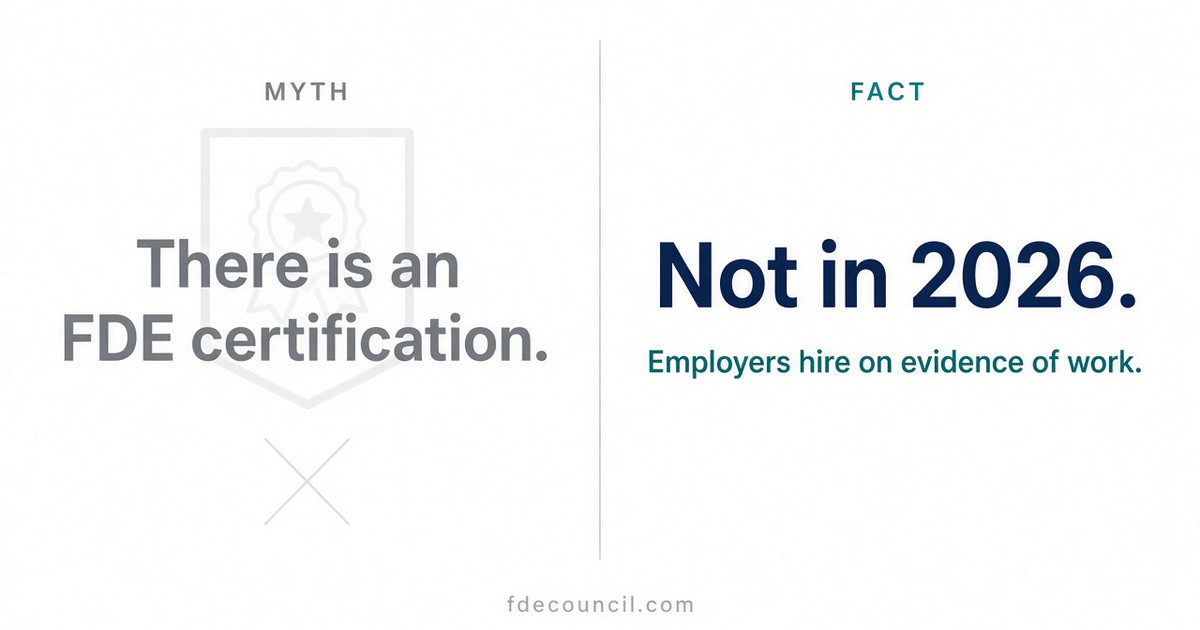
No. As of November 2026 there is no industry-wide, independently accredited certification of FDE competence. Employers hire on evidence of work. The FDE Council framework is a draft (v0.3) that has not been validated by a job task analysis, so nobody can be certified against it yet.
Is an FDE certificate worth it?
It depends on what it teaches. A course certificate can build skills, but it is not a certification of competence and no FDE posting cited here requires one. If you are targeting a platform company, a product certification for that platform is usually the better investment.
What is the difference between certified and aligned to a framework?
Certified means an independent body assessed you against a validated standard. Aligned means a course covers topics that map to a framework. The FDE Council framework allows training to say it is aligned to the open framework and nothing stronger.
Which certification helps most for FDE jobs?
A product certification for the platform the employer deploys, such as Palantir’s Foundry and AIP certifications or a Databricks certification. These show product knowledge. They do not show discovery, adoption, or handover skills, which you prove with a deployment case study.
Will FDE Council offer a certification?
Not now. The Council’s roadmap puts a job task analysis and a validated v1.0 framework first. Any later credential would be run under a separately governed committee, kept apart from training, and designed to be ready for ISO/IEC 17024.
Sources
- Institute for Credentialing Excellence, Certificate vs. Certification. Accessed November 15, 2026.
- ISO, ISO/IEC 17024:2026, Conformity assessment, General requirements for bodies operating certification of persons, published March 31, 2026. Accessed November 15, 2026.
- ANAB, Personnel Certification under ISO/IEC 17024. Accessed November 15, 2026.
- ASCB, ISO/IEC 17024: general requirements for bodies operating certification of persons. Accessed November 15, 2026.
- Palantir, Palantir Certification Framework. Accessed November 15, 2026.
- Databricks, Sr. Forward Deployed Engineer, job posting. Accessed November 15, 2026.
- OpenAI, Forward Deployed Engineer (FDE), SF, job posting. Accessed November 15, 2026.
- Anthropic, Forward Deployed Engineer, London, job posting. Accessed November 15, 2026.
- Palantir, Forward Deployed Software Engineer, New Grad, US Government, job posting. Accessed November 15, 2026.
- Ocrolus, Mortgage Forward Deployed Engineer, job posting. Accessed November 15, 2026.
- Cresta, How Cresta Built a World-Class Forward Deployed Engineering Team in a Year, October 6, 2026. Accessed November 15, 2026.
- Bloomberry, What I learned analyzing 1K forward deployed engineer jobs, updated January 25, 2026. Accessed November 15, 2026.
- FDE Council, Professional Capability Framework, draft v0.3, November 7, 2026.
How to cite this article
FDE Council. (2026, November 15). Is there a Forward Deployed Engineer certification in 2026? https://www.fdecouncil.com/insights/forward-deployed-engineer-certification/. Please also cite the original source of any figure you reuse.
Get new FDE Council articles by email
No more than once a month.
Basis: Employer job postings, the Institute for Credentialing Excellence, ANSI National Accreditation Board, ISO and Palantir pages accessed November 15, 2026, and FDE Council draft framework v0.3. The evaluation checklist is the Council’s synthesis. The Council’s text and tables are licensed CC BY 4.0; third-party figures remain under their sources’ terms. Not employment or financial advice.
More FDE Council Insights · Read the open competency framework
Related: How to become a Forward Deployed Engineer · How employers assess FDE skills · Map a learning path to the FDE framework.