
In brief
- In Bloomberry’s analysis of 1,000 FDE postings, 68% require travel (Bloomberry). Current postings range from 20% at Databricks to "up to 50%" at OpenAI.
- At Cresta, no single customer trip runs longer than about five days, most last two to three, and an FDE usually runs two to four projects in parallel (Cresta).
- A senior FDE at Rippling says he spends roughly equal time coding solutions and working with core product teams, and calls context-switching "an important skill to master" (Business Insider).
- The role has a reputation as a founder bootcamp. Business Insider counted around 700 LinkedIn profiles listing a founder role and Palantir as a former employer (Business Insider).
What does a typical FDE week look like?
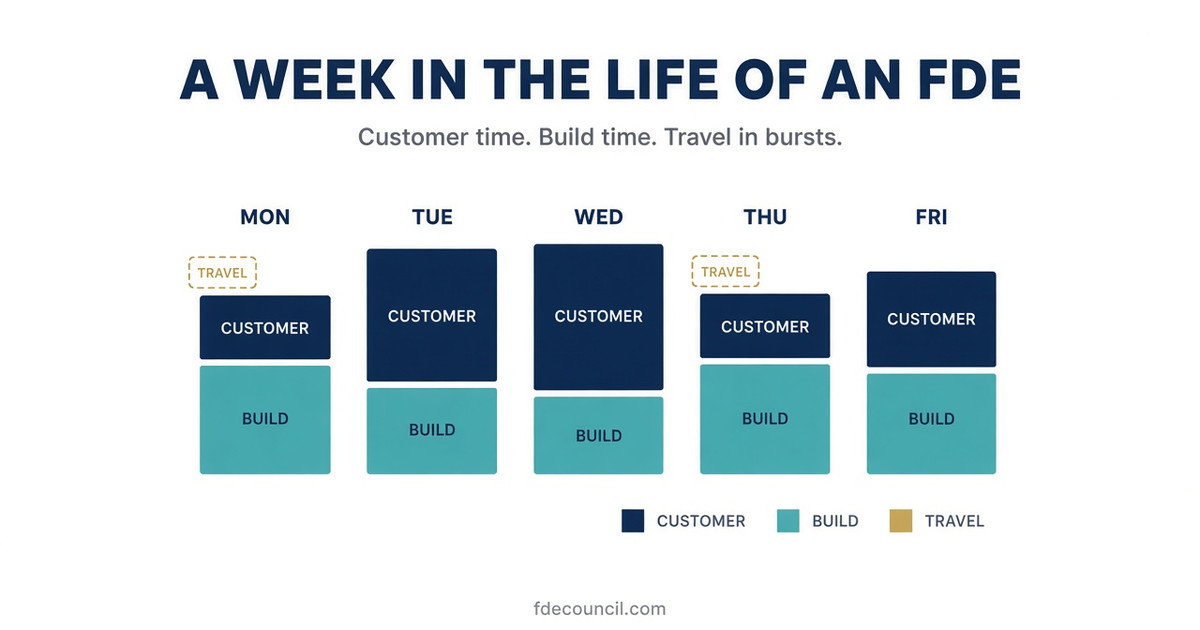
A mix of three kinds of work, in proportions that change every few weeks. Two Palantir FDEs described their weeks in 2019, as quoted by The Pragmatic Engineer (The Pragmatic Engineer):
- An FDE in Abu Dhabi: "Most weeks, I spend a couple of days working at the customer premises, some of that time in meetings with technical or business stakeholders, and the rest of the time monitoring, debugging, deploying, or configuring our software for that customer."
- An FDE in São Paulo: "Some weeks, I spend most of my time developing and reviewing my team’s code, like a typical software engineer. Other weeks, I spend most of my time scoping the future of a project with a client, or working with users."
The same article sums up a Palantir FDE week as customer project work first, then improving the company’s own platform when it gets in the way, then internal tasks such as standups and shared projects.
Here is how that usually breaks down across one week, using the FDE Council framework’s domains to name the work. The split is the Council’s reading of the sources above, not survey data:
| Kind of work | What it looks like | Framework domains |
|---|---|---|
| With the customer | Watching users do the job, scoping, demos of progress, explaining trade-offs, handling pushback | 1, 2, 9, 10 |
| Building | Code, integrations, data pipelines, evaluations, deployments in the customer’s environment | 3, 4, 5, 6, 7 |
| With your own company | Product feedback, reviewing teammates’ work, reusable components, internal syncs | 11 |
| Everywhere | Security reviews, approvals, access requests | 8 |
The 11 domains come from the open FDE Council Professional Capability Framework (draft v0.3). Few jobs touch all eleven in a single week. FDE work often does.
How much do Forward Deployed Engineers travel?
Usually between 20% and 50% of working time, set by the employer and the customer. Current postings:
| Employer and role | Travel stated in the posting |
|---|---|
| OpenAI, FDE (San Francisco) | "Travel up to 50% is required" (OpenAI) |
| Anthropic, FDE (London) | "Travel frequently (25-50%) to customer sites" (Anthropic) |
| Palantir, FDSE New Grad (US Government) | "Ability to travel 25-50% preferred, but requirements vary by team and location" (Palantir) |
| Ocrolus, Mortgage FDE | "Travel occasionally (~30-50%) to customer sites and industry events" (Ocrolus) |
| Databricks, Sr. FDE (Financial Services) | "Travel to customers 20% of the time" (Databricks) |
In a 20-day working month, 25% is about five days on site and 50% is about ten. Those are very different lives.
The shape of travel matters as much as the total. At OpenAI, projects start with a couple of days on site for scoping, and the delivery phase puts FDEs at the customer’s site "typically for a few days per week," according to its head of FDE (The Pragmatic Engineer). Cresta times trips "around discovery and around launch, since that’s when the most valuable learning happens," and does the rest remotely (Cresta).
Some sites cannot be reached any other way. A former Palantir FDE told The Pragmatic Engineer he worked on the final assembly line at Airbus, and that peers worked in similarly unusual places, including air-gapped environments with no remote access (The Pragmatic Engineer). If a company sells into defense, factories, or hospitals, expect more time on site.
How many projects does an FDE handle at once?
Often several. Cresta says an FDE "is usually running two to four projects in parallel," each staffed with two to three FDEs: one owns the technical design and key implementation, another reviews and picks up adjacent use cases, and sometimes a third advises (Cresta). Its agent deployments usually take one to three months from kickoff to production.
Parallel projects explain much of what FDEs say about the job. Monday can be discovery for a new customer, Tuesday a production fix for a live one, Wednesday a handover document for a third.
What is the hardest part of the job?
Switching modes many times a day, and owning things that break in someone else’s building. Kanav Bhatnagar, a senior FDE at Rippling, told Business Insider: "you could go from talking to a customer to debugging something to jumping onto another customer call shortly after." Coming from software engineering, he found that listening to customers "was a learning curve" (Business Insider).
Four pressures come up repeatedly in first-hand accounts:
- Context switching. Deep focus and diplomacy use different energy, and neither gets long uninterrupted blocks.
- Saying no. A Palantir FDE quoted by The Pragmatic Engineer limits meetings by asking "does this discussion have to be a meeting, and do I have to be there?" (The Pragmatic Engineer). Cresta asks candidates how they handled "a feature request you knew was wrong" (Cresta).
- Bad news. Cresta describes customer-facing maturity as "delivering bad news before the bad news delivers itself" (Cresta).
- Learning a new industry fast. OpenAI’s head of FDE writes that FDEs "don’t need to know the industry on day one but it is their responsibility to learn it." Some of his FDEs embedded with a chip maker’s verification team and studied chip design in their spare time (OpenAI).
We found no reliable published data on FDE working hours, so we do not quote a number. Ask each employer directly, and ask how on-call works for systems you deploy.
What is the best part of the job?
Seeing your work used, and learning how businesses actually run. Bhatnagar says software engineers "can feel far removed from customers," and that it is "very rewarding when a customer looks at what I’ve built after multiple iterations and says, ‘This is exactly what I wanted’" (Business Insider).
Published results show why the work is motivating. OpenAI reports that its semiconductor engagement reached production within three to six months, with about 48% time saved on directed test generation, and that the customer’s Chief Hardware Officer asked whether the FDEs had worked as chip designers before (OpenAI).
And the role builds range. Former Palantir FDEs who went on to found companies describe it in similar terms. Lisa Vo called it "founder preparation bootcamp"; Hex co-founder Barry McCardel said the dynamic "is what you ended up doing when you’re creating a new product as a founder" (Business Insider).
Is the FDE lifestyle a fit for you?
Score yourself honestly on eight statements. Each maps to a part of the job that does not go away:
- I can be away from home the share of time the posting states, in the pattern the team actually uses.
- I like explaining technical trade-offs to people who are not engineers, including when the news is bad.
- I am comfortable shipping a narrow version first and improving it with users.
- I can learn an unfamiliar industry’s language in weeks.
- I can hold two to four projects in my head without losing track of commitments.
- I am willing to own production problems in a system I built for someone else.
- I can say no to a customer request and keep the relationship.
- I write things down: runbooks, decisions, and handover notes.
If statements 1, 6, or 7 are hard no’s, a core product engineering role may suit you better. If most are yes, read the Council’s guide to becoming an FDE and check your gaps with the free self-assessment.
What should you ask an employer about the day-to-day?
Five questions reveal the real job behind the title:
- What does a typical month look like for an FDE on this team, in days on site? Ask for last quarter’s actual pattern, not the policy.
- How many projects does one FDE carry, and how are they staffed?
- Who is on call for systems FDEs deploy, and for how long after handover?
- What share of time goes to the core product? At Cresta, FDEs can open pull requests against the product directly (Cresta).
- Is there a quota? Bloomberry found no builder FDE posting that mentions one (Bloomberry). A quota changes the job.
The Council’s comparison of FDE, solutions engineer, and software engineer roles helps you read the rest of the posting. For what the work looks like stage by stage across a single deployment, see the FDE delivery lifecycle.
Frequently asked questions
How much do Forward Deployed Engineers travel?
Most postings ask for 20% to 50%. OpenAI says up to 50%, Anthropic 25% to 50%, Palantir’s new grad FDSE posting 25% to 50% preferred, and Databricks 20%. Travel often comes in bursts around discovery and launch rather than evenly across the year.
Can a Forward Deployed Engineer work remotely?
Partly. Much of the building happens remotely, but most FDE roles require regular time on site, especially at kickoff and go-live. Customers with air-gapped or restricted systems may require on-site work. Some roles state hybrid office requirements as well as travel.
Is being a Forward Deployed Engineer stressful?
It can be. First-hand accounts point to constant context switching, several parallel projects, travel, and owning production issues in a customer’s environment. People who enjoy variety and visible impact often describe the same features as the best part of the job.
How many projects does an FDE work on at once?
Often more than one. Cresta reports that its FDEs usually run two to four projects in parallel, each staffed by two to three FDEs with defined roles. Teams that embed one FDE with one large customer for months also exist.
What do FDEs do after a few years in the role?
Common paths include leading FDE teams, moving into product or engineering leadership, and founding companies. Business Insider counted around 700 LinkedIn profiles listing a founder role and Palantir as a former employer, and several founders credit the FDE role for preparing them.
Sources
- Bloomberry, What I learned analyzing 1K forward deployed engineer jobs by Henley Wing Chiu, updated January 25, 2026. Accessed November 13, 2026.
- Cresta, How Cresta Built a World-Class Forward Deployed Engineering Team in a Year by Jove Zhong, October 6, 2026. Accessed November 13, 2026.
- Business Insider, I’m a 24-year-old with the ‘hottest job in AI’, as told to Charissa Cheong, March 22, 2026. Accessed November 13, 2026.
- Business Insider, The Palantir job that grows startup founders by Samantha Stokes, June 4, 2025. Accessed November 13, 2026.
- The Pragmatic Engineer, What are Forward Deployed Engineers, and why are they so in demand? by Gergely Orosz, August 12, 2025 (cited sections are in the free preview). Accessed November 13, 2026.
- OpenAI, What FDE means at OpenAI by Colin Jarvis, October 22, 2026. Accessed November 13, 2026.
- OpenAI, Forward Deployed Engineer (FDE), SF, job posting. Accessed November 13, 2026.
- Anthropic, Forward Deployed Engineer, London, job posting. Accessed November 13, 2026.
- Palantir, Forward Deployed Software Engineer, New Grad, US Government, job posting. Accessed November 13, 2026.
- Ocrolus, Mortgage Forward Deployed Engineer, job posting. Accessed November 13, 2026.
- Databricks, Sr. Forward Deployed Engineer, job posting. Accessed November 13, 2026.
- FDE Council, Professional Capability Framework, draft v0.3, November 7, 2026.
How to cite this article
FDE Council. (2026, November 16). What is a day in the life of a Forward Deployed Engineer really like? https://www.fdecouncil.com/insights/forward-deployed-engineer-day-in-the-life/. Please also cite the original source of any figure you reuse.
Get new FDE Council articles by email
No more than once a month.
Basis: Employer postings and engineering blogs from OpenAI, Anthropic, Palantir, Databricks, Ocrolus and Cresta, plus The Pragmatic Engineer and Business Insider, accessed November 13, 2026; FDE Council draft framework v0.3. The work-type table is the Council’s reading. The Council’s text and tables are licensed CC BY 4.0; third-party figures remain under their sources’ terms. Not employment or financial advice.
More FDE Council Insights · Read the open competency framework
Related: How to become a Forward Deployed Engineer · FDE vs solutions engineer vs software engineer · The FDE delivery lifecycle.