
In brief
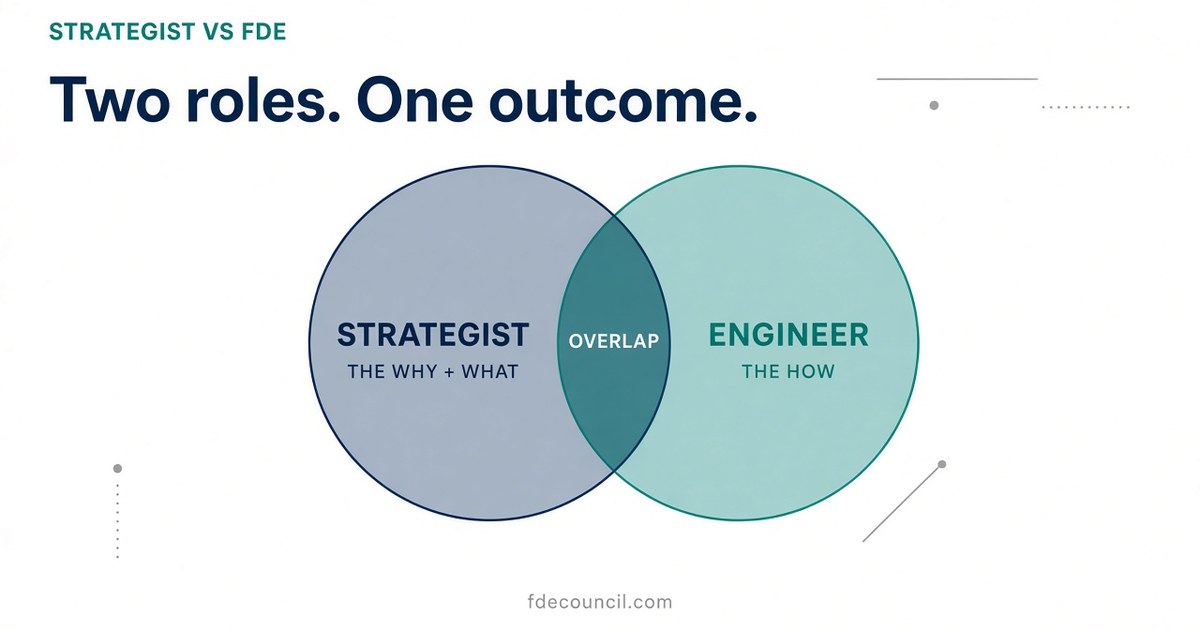
- Palantir’s careers page sums up the split in two lines: "Echos win" and "Deltas build." It adds that the roles are "intentionally designed to overlap" (Palantir).
- Databricks describes its deployment strategist as "the ‘product manager’ for the customer’s problem, responsible for the ‘why’ and ‘what,’ while our FDEs (Engineers) will be your partners responsible for the ‘how’" (Databricks).
- A New York FDE community founder told Business Insider his company pairs each FDE with a deployment strategist, a role that keeps the project moving but does not do the coding (Business Insider).
- People move between the two. Bloomberry’s sample of FDE profiles includes former Palantir deployment strategists who became FDEs (Bloomberry).
What is a deployment strategist?
A deployment strategist is a customer-embedded product manager. They find the problem worth solving, align the people who decide, define what success looks like, and steer the project to adoption.
Palantir’s own description of Echos lists the work: "identifying the true problem limiting our partner’s mission, decomposing that problem into its component workflows, aligning stakeholders from the CIO to the nurse, solving backwards from a user’s workflow, building the technical software and/or AI solution, and ultimately moving Western institutions forward." It calls Echos "facilitators, complementing technicality with leadership" (Palantir).
A Palantir blog post on the role says that in theory "Echos are more product-managers while Deltas are more technical, but in reality, both roles are a mix between product manager, software engineer and strategist and the lines between the two roles blur heavily quite often." It describes strategists whose days range from writing code all day to focusing on client relationships, project coordination, and mentoring (Palantir Blog).
Databricks has adopted the title outside Palantir. Its posting asks a deployment strategist to quantify the value of "$10M+ problems," define the pilot’s minimum viable product and success criteria, write the product requirements document, prioritize the engineering backlog, act as "the primary hands-on QA tester," and own "the ‘Day 0’ launch" through to adoption (Databricks).
What is a Forward Deployed Engineer?
An FDE is a software engineer who embeds with a customer and is judged on a working outcome in production. Palantir’s line for Deltas is: "Your job is to ensure the solutions we build actually work. In a world of demo-ware and big promises, a Delta delivers tangible outcomes" (Palantir). The FDE Council definition of a Forward Deployed Engineer covers the role in full.
How do the two roles compare side by side?
| Deployment strategist ("Echo") | Forward Deployed Engineer ("Delta") | |
|---|---|---|
| Core question | Are we solving the right problem, and will people use it? | Does the solution actually work in production? |
| Owns | Problem framing, stakeholders, scope, success criteria, adoption | Architecture, code, integrations, data pipelines, reliability |
| Main artifacts | Value case, pilot definition, requirements document, backlog, launch plan | Working system, evaluations, deployment, runbook |
| Writes production code? | Sometimes; varies widely | Yes |
| Closest neighbor | Product manager, consultant | Software engineer |
| Databricks experience ask | Typically 7+ years delivering customer-facing data, AI, or software engagements | 6+ years in data engineering, platforms, or software (Sr. FDE) |
| Databricks on-site time | Often 25% to 50%, sometimes higher | 20% (Sr. FDE) |
Experience and travel rows come from two Databricks postings, a Deployment Strategist role listed as remote in India and a Sr. FDE role in New York City (Databricks DS; Databricks FDE). Other employers differ, so treat the table as each role’s center of gravity, not a fixed boundary.
How do the roles map to the FDE Council framework?
They split the same 11 domains differently. The FDE Council Professional Capability Framework (draft v0.3) says every FDE should develop capability in all eleven core domains (framework). That does not mean every person leads every domain on every project. On a paired team, leadership usually divides like this. This is the Council’s reading of the postings above, not survey data:
| Domain | Usually led by | Usually supported by |
|---|---|---|
| 1. Discovery and problem framing | Strategist | FDE |
| 2. Workflow design and value definition | Strategist | FDE |
| 3. Solution architecture and enterprise integration | FDE | Strategist |
| 4. Data foundations and engineering | FDE | |
| 5. Software engineering and rapid experimentation | FDE | |
| 6. Verification, evaluation and outcome measurement | Shared: FDE for technical evidence, strategist for business outcome | |
| 7. Production deployment, reliability and operations | FDE | Strategist for launch and support plan |
| 8. Security, privacy, safety and governance | FDE for controls | Strategist for approvals |
| 9. Embedded collaboration, trust and adoption | Strategist | FDE |
| 10. Delivery and commercial judgment | Strategist | FDE |
| 11. Field learning, product feedback and reuse | Shared |
The table shows why the framework still expects FDEs to build capability in Domains 1, 2, 9, and 10. On a team without a strategist, nobody else will do that work. And even on a paired team, an FDE who cannot frame a problem will build the wrong thing quickly.
Why do some companies have strategists and others do not?
Cost, deal size, and how technical the customer-facing work is. Three patterns show up in public sources:
- Paired teams for large, executive-sponsored deals. Databricks says its FDE team exists to "win C-suite-sponsored, high-value AI opportunities by selling and delivering outcomes, not just a platform," with strategists embedded "from the very first sales call" (Databricks).
- Strategist-like roles under other names. Andreessen Horowitz describes Decagon’s "Agent Product Managers," a sizable team of relatively technical PMs who work with customers to stand up AI support agents (a16z).
- FDEs doing both. Many smaller AI companies hire only FDEs. Bloomberry found 58% of FDE roles are at companies with 11 to 200 employees (Bloomberry), where a separate strategist on every account is rare.
Andreessen Horowitz also warns about what goes wrong when the pairing is copied without the substance: "we’ll build a Palantir-style FDE team" can degrade into "pre-sales solution engineers relabeled as ‘FDEs’" or junior generalists asked to do product, implementation, and account management at once (a16z).
Which role should you aim for?
Choose by what you want to be accountable for. Use these four questions:
- When a project slips, do you want to fix the code or fix the plan? Code points to FDE; plan points to strategist.
- Do you write production code today, and want to keep doing it most days? If yes, FDE.
- Do you have deep domain knowledge, such as healthcare operations, lending, or logistics, that engineers lack? That is a strategist’s edge.
- Are you comfortable owning a business number with executives? Strategists usually carry the value case.
Neither role is a lesser version of the other. A former Palantir FDE who co-founded the data workspace startup Hex described the FDE work as engaging with "a hard problem" and solving it "with deep customer empathy and lots of ingenuity" (Business Insider). Strategists bring the same empathy from the problem side.
If you are an engineer aiming for FDE, read the Council’s guide to becoming a Forward Deployed Engineer. If you are weighing FDE against other technical roles, see FDE vs solutions engineer vs software engineer.
How should a paired team divide the handoff?
Write it down. The most common failure on paired teams is the strategist’s understanding of the problem never reaching the code. A one-page brief, updated every week, closes that gap:
- Problem and owner: the problem in the user’s words, and who decides.
- Baseline and target: the number today and the number that counts as success.
- Smallest slice: what ships first, and what is deliberately left out.
- Constraints: data access, approvals, security rules, deadlines.
- Evidence plan: how both business and technical success will be shown. The Council’s guide to measuring FDE deployment success lists the four kinds of evidence.
- Stop conditions: what would make you reshape or stop.
- Open questions: who owns each, and by when.
When one FDE plays both roles, the brief matters even more: it is the only check that you are still building for the problem you agreed.
Frequently asked questions
What is a deployment strategist at Palantir?
A deployment strategist, called an "Echo" at Palantir, owns the problem side of a customer engagement: finding the true problem, decomposing it into workflows, aligning stakeholders, and driving adoption. Palantir says Echos complement technicality with leadership, and that the role overlaps deliberately with its FDEs.
Is a deployment strategist the same as a product manager?
Close, but embedded with one customer. Databricks calls its deployment strategist a "product manager for the field" who writes requirements, prioritizes the engineering backlog, and owns launch and adoption. Unlike most product managers, strategists sit inside a single customer’s organization.
Do deployment strategists code?
Sometimes. Palantir describes strategists whose days range from writing code all day to focusing on client relationships and project coordination. Databricks asks for proficiency in at least one language such as Python, Java, or SQL, and the ability to read code and build prototypes, but the engineers own production code.
Can a deployment strategist become a Forward Deployed Engineer?
Yes. Bloomberry’s review of FDE profiles includes former Palantir deployment strategists who moved into FDE roles. The usual gap is production engineering: shipping and operating code in a customer’s environment, not just specifying it.
Do all companies with FDEs have deployment strategists?
No. Many smaller AI companies hire only FDEs, who then handle discovery, stakeholders, and adoption as well as the build. Paired teams are more common for large, executive-sponsored engagements, as in Databricks’ FDE organization.
Sources
- Palantir, Careers: Echos, Deltas, and Devs. Accessed November 17, 2026.
- Palantir Blog, A day in the life of a Palantir Deployment Strategist. Quoted text confirmed November 17, 2026.
- Databricks, Deployment Strategist, job posting. Accessed November 17, 2026.
- Databricks, Sr. Forward Deployed Engineer, job posting. Accessed November 17, 2026.
- Business Insider, I run the first forward-deployed engineer club in New York, as told to Katherine Li, November 7, 2026. Accessed November 17, 2026.
- Business Insider, The Palantir job that grows startup founders by Samantha Stokes, June 4, 2025. Accessed November 17, 2026.
- Andreessen Horowitz, Trading Margin for Moat by Joe Schmidt, June 4, 2025, and The Palantirization of everything by Marc Andrusko, January 16, 2026. Accessed November 17, 2026.
- Bloomberry, What I learned analyzing 1K forward deployed engineer jobs, updated January 25, 2026. Accessed November 17, 2026.
- FDE Council, Professional Capability Framework, draft v0.3, November 7, 2026.
How to cite this article
FDE Council. (2026, November 17). Deployment strategist vs Forward Deployed Engineer: what is the difference? https://www.fdecouncil.com/insights/deployment-strategist-vs-forward-deployed-engineer/. Please also cite the original source of any figure you reuse.
Get new FDE Council articles by email
No more than once a month.
Basis: Palantir, Databricks, Business Insider, Andreessen Horowitz and Bloomberry pages accessed November 17, 2026, and FDE Council draft framework v0.3. The domain split is the Council’s reading of the postings, not survey data. The Council’s text and tables are licensed CC BY 4.0; third-party figures remain under their sources’ terms. Not employment or financial advice.
More FDE Council Insights · Read the open competency framework
Related: FDE vs solutions engineer vs software engineer · How to become a Forward Deployed Engineer · The FDE delivery lifecycle.